Huck and Jim, or James and Huck?
Though I focus on Jane Austen and her times or more broadly on women’s literature, from time to time I venture into other areas of literature that interest me. One such place involves the pairing of the American novels Adventures of Huckleberry Finn by Mark Twain (1884, set pre-Civil War) and James by Percival Everett (2024). Both tell the story of the white boy and black man running for freedom together down the Mississippi River. Huck, by a white author, is told from the boy’s perspective; James, by a black author, is from the man’s.
After reading just the first few pages of James on its release, I knew I needed to return to the original to refresh my memory before continuing. They were that different and yet that inextricably linked by character and theme. And both are important in US fiction.
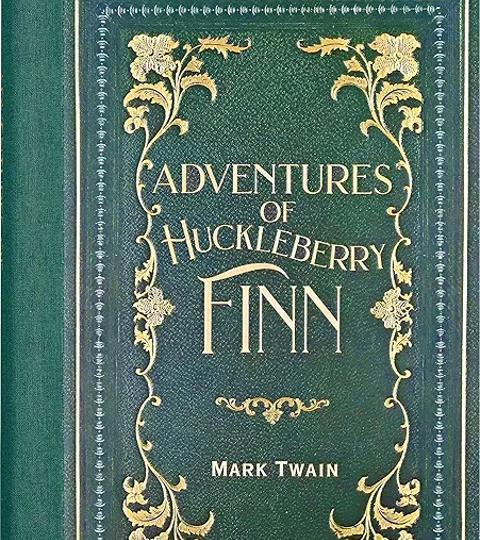
Mark Twain’s 1884 Huckleberry Finn
Ernest Hemingway said that “all modern American literature” comes from Huck Finn: “There was nothing before. There has been nothing as good since.” The novel describes the growing relationship between the young white teenager and the enslaved black man in his mid-thirties. The novel deals realistically with the injustice of slavery and the dangers that Jim faces as a runaway slave. At least some readers, however, feel that Twain uses demeaning racial language to depict Jim.
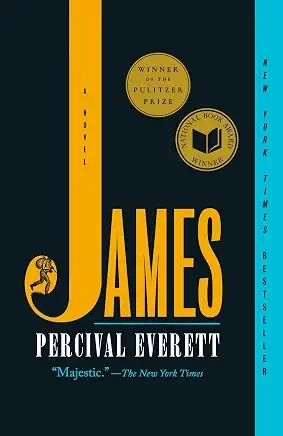
Percival Everett’s 2024 James
Written 140 years later, James won the National Book Award and the Pulitzer Prize, among other honors. By reversing the perspective, Everett can show that James, his actual name, is much better educated and far less subservient than the Jim of Twain’s novel. James doesn’t just support Huck, he also fights for what is his—especially his family—and for justice.
It is easy to understand why Hemingway found Huck Finn compelling. It does not flinch at showing white venality and violence. It uses language as ordinary people spoke it—counter the fancy language associated with “literature.” It uses irony, sometimes quite broadly, to expose the evils of slavery. In James, the black man well understands the many ironies of his situation—at one point he’s a black man pretending to be a white man in blackface pretending to be a black man—but he cannot use the word “irony” without appearing uppity.
A subversive joke in James is that black people speak the king’s English among themselves, reserving the traditional downhome dialect for use only with whites so that the latter can feel superior. James gives black kids lessons to ensure that they use the “correct incorrect grammar” in front of whites (chapter 1). The hero is caught a couple of times speaking too well and must misarticulate his way out.
Twain’s plain but vivid descriptions find echoes in Hemingway’s own prose, as this in chapter 19: “Once or twice … we would see a steamboat slipping along in the dark … [belching] a whole world of sparks … and they would rain down in the river and look awful pretty; then she would turn a corner and her lights would wink out and … by and by her waves would get to us … and joggle the raft a bit.”
By design, James’s narrative language is less colloquial than Huck’s, but Everett does have the boy remark about being run over by such a steamboat: “That big paddle was just chopping up that water like your granny beatin’ eggs” (chapter 19).
Twain stumbles seriously at times. Huck Finn is a companion piece to his earlier The Adventures of Tom Sawyer (1876), a young adult novel about a good-natured scamp who commits generally harmless pranks and gets into generally harmless trouble. Tom Sawyer slowly grows more serious—almost as if Twain is dragged along by a subconscious desire to write more deeply than he has to this date as a tongue-in-cheek travel correspondent.
Trying to tie the books together, Twain has Tom pop up in Huck Finn for no believable reason after Huck and Jim survive many frightening moments on the run. Tom begins his absurd hijinks again. Only now, they’re not funny. Tom already knows that Jim has been freed, yet he continues the charade of his enslavement so that Tom can be the one to rescue him. All the while, Jim is locked in a small shed and chained up at night. The eventual escape has Jim being nearly shot or lynched by white slavecatchers, and Tom himself is wounded. The novel ends happily when all is revealed, but Tom’s trivial intrusion is not to his credit—or Twain’s.
Though written sympathetically about a black man at a time when post-Civil War racial violence was increasing in the US, Huck Finn has been scorned today for the excessive use of the n-word, 219 times in about four hundred pages. Many readers, especially people of color, have been so offended that they cannot finish the book. For at least twenty years, some parents and teachers nationwide have called for the book to be banned. This view is encapsulated by teacher John Foley from Washington state, who says that “novels that use the ‘n-word’ extensively need to go.”
To reduce the nastiness, one edition was published with the word “slave” replacing the n-word. Reaction was harsh, including by well-regarded black authors and commentators. Critic Jamelle Bouie, for instance, says that expurgating novels of racist terms is nothing more than “peddling whitewashed ignorance [that] diminishes America as much as it does our intellect.”
Though I well understand that no person of color wants to hear or see the n-word ever again, context matters. Twain does not use the word blindly or as an implicit racist himself. He calls out racism too often throughout the novel for those accusations to be true. The most important scene in Huck’s maturation comes in chapter 16. Jim is becoming excited as they near Cairo, Illinois, where he would be free—and where he could earn money to buy his family’s freedom.
Simultaneously, Huck wrestles with his conscience because he’s abetting the escape of a white woman’s “property.” But when pressed by white slavecatchers about his traveling companion, Huck says the man is white—and sick with smallpox. The manhunters scurry away. Later, after Jim has been recaptured and sold, Huck realizes that he must “decide, forever, betwixt two things”—being Jim’s friend or following the slavery laws. He sets out to free Jim, even though he knows this “crime” will send him “to hell” (chapter 31).
Huck sometimes continues to use the n-word after he has intentionally accepted Jim as a human being, but I’ll take a conscious act of morality over a reflexive racist habit any day. The point of Huck Finn is to contrast the despicable way that Jim is treated and described by whites with the reality that he is the only decent, caring adult male figure in the novel. Especially as it comes to the treatment of Huck. A good parental figure, we would say today.
Everett himself uses the n-word sixty-one times in about three hundred pages, less than half the amount of Twain. But it’s still a lot. Does the author’s ethnicity enable readers to assume that the usage is better considered or is more acceptable? Really, Everett has no choice if he is to describe the way whites talked before (and after) the Civil War. The difference is that he can show James’s response. Including his remark that he’s a slave but not the other.
In modern times, use of the n-word is limited (preferably to zero). But writers may make the difficult choice to use it. In my biography Running Against the Wind, the black subject, William R. (Bill) Brooks, insisted on my using the n-word six times. Sometimes the use was to emphasize the ugliness of the word, sometimes the use was to emphasize the ugly reaction to it.
Critics of Twain’s depiction of Jim fail to consider his introduction of a black college professor in Ohio who “could talk all kinds of languages, and knowed everything.” That this black man can vote drives Huck’s father to distraction, since he’d be voting too “if I warn’t too drunk to get there.” Pap’s follow-on racist rant could spew from the mouth of any cracker who ever lived (chapter 6). The passage contrasts knowledge on the black side with ignorance on the white, showing that Jim’s circumstance stems from a lack of education and opportunity rather than a lack of intelligence.
By centering the action on James, Everett can address virtually every crime against the enslaved population, from the least obvious—a lack of firewood on cold nights—to rape, murder, and lynching. James’s nightmares enable him to debate Western philosophers who support freedom and equality for everyone but black people. James is able to directly confront and sometimes physically battle the evils of the day. His victories are not without serious loss.
Everett makes one important change to the storyline that I understand, yet to me his approach constricts somewhat the humanity found in the Jim of Twain’s novel. To say more would be a spoiler. In a critical moment, the men in both novels act on good impulse, but James acts for a specific reason while Jim acts more generally.
A quarter of a century ago, a black woman near where I was living demanded that the local schools remove Huck Finn from the school curriculum because she didn’t want her granddaughter exposed to the n-word and other racist actions in the book. My thought then was that you don’t ban one writer’s story but rather you tell your own. Everett has told James’s story in a way that reveals more about the life of enslaved Americans than most of us would ever know and in a way that should resonate with any open and humane mind.
——
My newest book, Running Against the Wind: A Black Arkansan’s Pursuit of His Dream, brings the historical thread to the present. Running is both a biography of one man, Bill Brooks, and a history of black life in the US today. Bill’s life shows how a black man’s pursuit of happiness remains difficult and even dangerous in America today. Available from Amazon in print, digital, and audio form.
The Marriage of Miss Jane Austen is available in print form from Jane Austen Books and Amazon. A “boxed set” that combines all three in an e-book format is also available along with audiobooks of the individual novels.
My book Jane Austen and the Creation of Modern Fiction: Six Novels in “a Style Entirely New” investigates her development as a writer and shows how her innovations as a prose stylist set the course for modern fiction. It is available from Jane Austen Books.