Unexpected Moments of Reaching Out
One scene has kept me coming back to George Eliot’s Middlemarch for fifty years. Dorothea, a young and engaging woman, has married an older man, clergyman Mr. Casaubon, out of an intellectual and religious ardor for his scholarship. After just eighteen months, she realizes that she is trapped in a loveless marriage with a third-rate pedant. Her husband not only dismisses her possible contributions, but he also will never complete his magnum opus. His “ungauged reservoir” of mind turns out to be empty, his work nothing but a “lifeless embalmment of knowledge.” He is jealously cruel to a younger male relative, Mr. Ladislaw, who has become Dorothea’s friend.
One evening Dorothea stands in the hallway waiting for Mr. Casaubon, now suffering from serious heart disease, to come up from his study. She is brimming with disdain, resentment, and possibly hatred, expecting nothing but one “pang” after another going forward in life. Her emotions build. The reader expects, and perhaps hopes, that she will finally unload on her humorless, overbearing husband for his self-centered cruelty. Here’s what happens instead when he comes up the stairs (book V, ch. 42):
“Dorothea!” he said, with a gentle surprise in his tone. “Were you waiting for me?”
“Yes, I did not like to disturb you.”
“Come, my dear, come. You are young, and need not to extend your life by watching.”
When the kind quiet melancholy of that speech fell on Dorothea’s ears, she felt something like the thankfulness that might well up in us if we had narrowly escaped hurting a lamed creature. She put her hand into her husband’s, and they went along the broad corridor together.
Perhaps the greatest moment of sympathy I’ve ever read involves a man who does not deserve any. Sometimes I re-read and marvel at the passage. Sometimes I rescan the novel in search of many other brilliantly rendered intense, emotional moments. Most recently, I carefully re-read and studied the book in its entirety.
Eliot (Mary Ann Evans using a male pen name) sits in the great constellation of British authors from Austen to the Brontës to Dickens to Hardy to Woolf. (Gaskell, Trollope, and Thackeray, though they have their admirers, are to me one step down.) Virginia Woolf called Middlemarch “one of the few English novels written for grown-up people.” A BBC cultural poll (Jane Ciabattari, 7 December 2015) ranked the book as the best British novel of all time. (This is an odd poll, involving eighty-two English-speaking book critics from outside the UK to select the top hundred novels. Four of Austen’s novels make the list, though oddly not Mansfield Park.)
Eliot and Austen in many ways are opposites. Austen wrote tight, focused stories. Though she speaks of three or four families in a country village as being just the thing to write about, we usually see only one family in depth. Other families and the broader community orbit the scene, slightly out of focus. Eliot draws broad landscapes and people-scapes, then narrows into each domestic setting and conflict. Whereas Austen as narrator remains close, the camera over each heroine’s shoulder, Eliot keeps a narrative distance, doing more long shots while coming in to capture the emotional essence of life-changing moments.
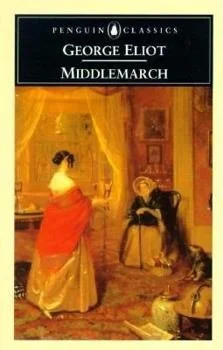
Middlemarch, according to Virginia Woolf, is “one of the few English novels written for grown-up people.”
Often compared to War and Peace for its scope, Middlemarch resulted from Eliot melding two different works into a single plan. Each of the storylines is a novella in itself, and Eliot weaves them together intelligently.
The result is that we see local society from top to bottom and left to right. Social drama and personal drama intertwine, driving conflict. Marriages ravel and unravel, often as the result of social expectations, demands, or prohibitions. The same pressures thwart other romances. Reputations rise or fall based on individual rumors and community-wide innuendo either true or false. People compromise for good and bad reasons.
Eliot’s development into the Victorian era’s most sophisticated novelist might be surprising when we look at her early work. Though well known (short enough for most curricula), her early works Adam Bede, Mill on the Floss, and Silas Marner show little potential for deep psychological analysis. Yet, like Austen’s first novels, these tales of provincial realism taught her how to write.
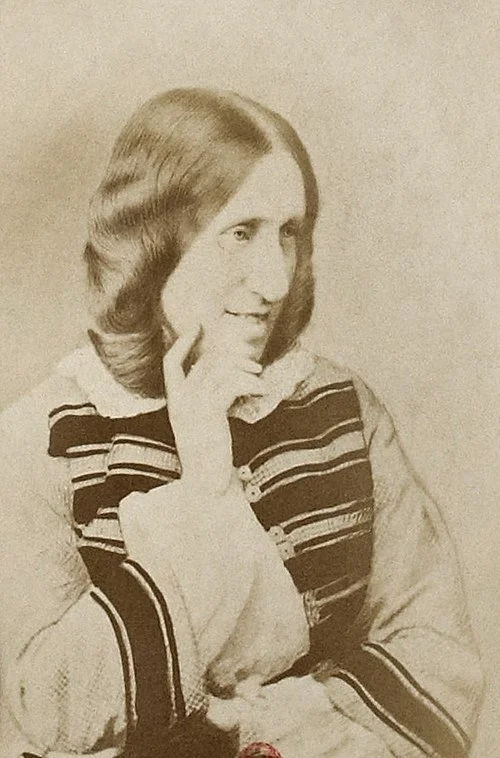
George Eliot (Mary Ann Evans) grew from simple provincial stories to deep psychological studies.
Eliot’s first big book, the 730-page Romola, historical fiction set in fifteenth-century Florence, met with mixed reception. Some considered it her best work; others thought it was too erudite. Trollope feared that Eliot “fire[d] too much over the heads of her readers.” Yet critic William Skidelsky of the Observer considers it one of the ten best historical novels of all time.
Social issues come to the fore as Eliot matures. Sometimes, too much so. Her last novel, Daniel Deronda, alternates psychological insights into characters with extensive commentary on the maltreatment of Jews in Victorian England. Some readers wanted the social analysis removed to focus on the literature, while others wanted the literature removed to focus on the social analysis.
Middlemarch’s only weakness is this same dense intrusion of social issues into the storyline. One example is an early four-page disquisition on the status of physicians in society. Similar excess commentary on the medical profession or medical practices arises whenever the good doctor Lydgate shows up. This passage does have medical comment relevant today: “since professional practice chiefly consisted in giving a great many drugs, the public inferred that it might be better off with more drugs still.”
Other times, the text, written in 1872 while set in 1832, pushes onto the reader excessive background on the 1832 Reform Acts being debated countrywide to broadly increase voting rights and ease other ills. The local elections seem more a way for the author to create parallels with Victorian times than to provide a way for individuals to display their character.
We must simply wade through these sections.
More often, we see brief or expanded passages of human insight or unusual but adept turns of phrase:
A young man gives his addled aunt some candies while “she was making tender little beaver-like noises.”
Dorothea is “carrying on her thoughts as if they were a speech to be heard by her husband.”
Ladislaw feels that he and Dorothea “were like two creatures slowly turning to marble in each other’s presence, while their hearts were conscious and their eyes were yearning.”
On politics, one person laments: “He’s such a low fellow, that I wished he had been on the wrong side” of an issue.
After Lydgate and Rosamond have for a long time circled in silence and shyness:
“She felt that her tears had risen, and it was no use to try to do anything than let them stay like water on a blue flower or let them fall over her cheeks, even as they would. That moment of naturalness was the crystallising feather-touch: it shook flirtation into love.”
All of Eliot’s characters are flawed. Social-climbing Rosamond is a good example. But Eliot always opens her heart and pen to them at unexpected moments. Like Dorothea, almost everyone offers a hand to another when most of us wouldn’t.
---
My book Jane Austen and the Creation of Modern Fiction: Six Novels in “a Style Entirely New” investigates her development as a writer and shows how her innovations as a prose stylist set the course for modern fiction. It is available from Jane Austen Books at a special low price.
The Marriage of Miss Jane Austen is also available from Jane Austen Books and Amazon. The trilogy traces love from a charming courtship through the richness and complexity of marriage and concludes with a test of the heroine’s courage and moral convictions. A “boxed set” that combines all three in an e-book format is also available.
My newest, non-Austen, work is Running Against the Wind: A Black Arkansan’s Pursuit of His Dream, which describes how a black man’s pursuit of happiness remains difficult and even dangerous in America today. Available from Amazon.